

VAT. Three letters that send a lot of Filipino freelancers into a panic. The moment someone mentions it in a freelancing Facebook group, the thread explodes with confusion, conflicting advice, and a lot of "Wag mo munang pansinin yan tutal nagsisimula ka palang naman." But here is the thing: understanding VAT is not as complicated as it sounds, and knowing whether it applies to you can save you from a lot of unnecessary stress and potential penalties down the road.
This guide will walk you through everything you need to know about VAT as a Filipino freelancer in plain, practical terms. No accounting jargon. No unnecessary complexity. Just the facts you actually need.
What is VAT and Why Should Freelancers Care
VAT stands for Value Added Tax. In the Philippines, it is a 12% consumption tax on goods and services. Think of it as the government's way of collecting a share of the value generated every time a product is sold or a service is rendered. When you dine at a restaurant and see "VAT included" on your receipt, that 12% went to the Bureau of Internal Revenue (BIR).
For freelancers, VAT matters in two specific ways. First, it determines whether you are required to add 12% on top of your service fees when billing your clients. Second, it affects how much you pay when using freelance platforms like Upwork or Fiverr since those platforms now charge VAT on their service fees under a 2024 law.
The good news is that VAT is not a concern for most Filipino freelancers who are just starting out or earning at moderate income levels. The BIR has set a clear threshold that determines when VAT becomes mandatory, and the majority of Filipino freelancers fall well below that threshold. Para sa mga terms na hindi mo pa pamilyar, tingnan ang aming Freelancing Terms Glossary para sa Filipino Beginners.
The 3 Million Peso Threshold Explained
The single most important number you need to know about VAT as a Filipino freelancer is ₱3,000,000. This is the annual gross sales or receipts threshold set by the BIR under the TRAIN Law. Your entire VAT situation depends on which side of this threshold you are on.
Non-VAT Registered
You are not required to register for VAT. You pay either 3% percentage tax or opt for the 8% flat income tax rate instead. No need to add 12% to your client invoices.
Mandatory VAT Registration
You must register as a VAT taxpayer with the BIR. You are required to file regular VAT returns and may need to charge VAT on certain transactions depending on your client's location.
Voluntary Registration
Even below ₱3M, you can choose to register for VAT if you want to claim input VAT credits on business expenses like equipment, software, or platform fees.
It is worth noting that the ₱3M threshold refers to your annual gross receipts, meaning the total amount you receive from clients before any deductions. This includes all freelance income regardless of whether payment came through PayPal, Wise, GCash, direct bank transfer, or any other channel. Hindi lang ang income mula sa iisang client ang binibilang. Lahat ng iyong freelance income combined for the year counts toward this threshold.
Quick context: At the current BSP exchange rate of approximately ₱61.55 per USD as of July 2026, the ₱3M threshold is equivalent to roughly $48,700 USD per year or about $4,060 USD per month. Most Filipino freelancers who are just starting out or earning at a moderate level are well below this threshold. For the latest exchange rates, refer to the Bangko Sentral ng Pilipinas website.
Below 3 Million Pesos: What You Pay Instead of VAT
If your annual freelance income is below ₱3M, you are classified as a non-VAT taxpayer. This means you do not add 12% VAT to your client invoices and you are not required to file VAT returns. Instead, you have two primary tax options for your income.
Option 1: The 3% Percentage Tax
The percentage tax is a simpler alternative to VAT for non-VAT registered freelancers and self-employed individuals. Under this option, you pay 3% of your gross receipts every quarter to the BIR, regardless of whether you made a profit or not. It is straightforward but can feel heavy during slow months since it is based on income received not income earned after expenses.
Option 2: The 8% Flat Income Tax Rate
Under the TRAIN Law, qualified self-employed individuals and professionals with annual gross receipts not exceeding ₱3M may opt for an 8% flat income tax rate on gross sales or receipts in excess of ₱250,000. This replaces both the regular income tax and the 3% percentage tax. For many freelancers, this option is simpler and more tax-efficient. However, it is an irrevocable election for the entire taxable year so you need to choose carefully.
Practical Example: Comparing Tax Obligations
Freelancer: Camille, a Social Media Manager from Quezon City earning ₱1,200,000 per year (approximately $19,500 USD) from international clients through PayPal.
Under 3% Percentage Tax: Camille pays ₱36,000 per year (3% of ₱1,200,000) in percentage tax plus her regular graduated income tax on net income.
Under 8% Flat Rate: Camille pays 8% of ₱950,000 (₱1,200,000 minus the ₱250,000 exemption) which is ₱76,000 per year. This replaces both the percentage tax and the graduated income tax, making her total tax computation much simpler.
Does Camille need VAT? No. She is well below the ₱3M threshold and is not required to register for VAT or add 12% to her client invoices.
For guidance on your government contribution obligations as a freelancer beyond taxes, including SSS, PhilHealth, and Pag-IBIG, refer to our PhilHealth SSS at Pag-IBIG para sa Filipino Freelancers guide.
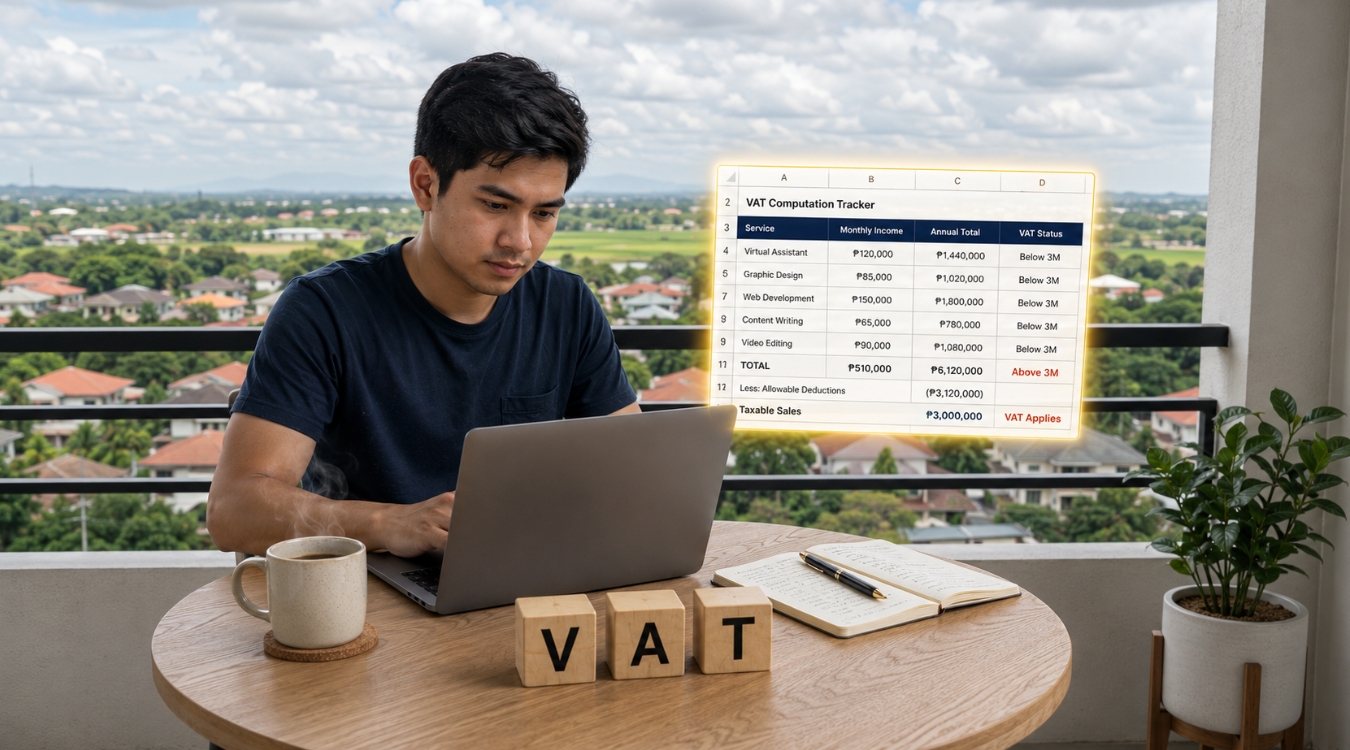
Understanding the ₱3M VAT threshold is the single most important step in knowing whether VAT applies to your freelance business. Most Filipino freelancers are well below this threshold.
Above 3 Million Pesos: What VAT Registration Actually Means
If your annual freelance income exceeds ₱3M, congratulations are genuinely in order. That level of income means your freelance career is doing exceptionally well. But with that milestone comes the mandatory requirement to register as a VAT taxpayer with the BIR.
What VAT Registration Requires
Once you cross the ₱3M threshold, you need to update your BIR registration to reflect your VAT status. This involves filing BIR Form 1905 to update your registration, securing a new Certificate of Registration reflecting your VAT status, and starting to issue VAT-official receipts or invoices that reflect the applicable VAT rate. For a comprehensive guide on BIR registration as a freelancer, refer to our DTI vs BIR: Ano ang Kailangan ng Filipino Freelancer guide.
Quarterly VAT Filing Requirements
As a VAT-registered taxpayer, you will need to file quarterly VAT returns using BIR Form 2550Q and monthly VAT declarations using BIR Form 2550M. These filings compute the difference between your output VAT which is the VAT you collected from clients and your input VAT which is the VAT you paid on business expenses. The net amount is what you remit to the BIR.
Important: The obligation to register for VAT kicks in when you exceed ₱3M within any 12-month period, not necessarily the calendar year. If your freelance income crossed ₱3M by July of a given year, you are already required to register even if the calendar year has not ended. Consult a licensed accountant or the BIR directly for guidance specific to your situation. Refer to the BIR official website for the latest registration requirements and procedures.
Zero-Rated Exports: The Part Most Filipino Freelancers Miss
This is the section that changes everything for VAT-registered freelancers who primarily serve international clients. Here is the misconception most people have: they think that becoming VAT-registered means they need to charge their international clients an additional 12% on top of their rates. That is not how it works.
Under Philippine tax law, services rendered to foreign clients and paid for in acceptable foreign currency are classified as zero-rated or export services. Zero-rated means that the VAT rate applicable to those transactions is 0%, not 12%. Sa madaling salita: kung ang iyong clients ay international at nagbabayad sa iyo in foreign currency through PayPal, Wise, Payoneer, or wire transfer, your services are zero-rated and you do not charge them any additional VAT.
What Zero-Rated Actually Means in Practice
If you are a VAT-registered Filipino freelancer earning ₱4,500,000 per year from US and Australian clients through Upwork, here is how it looks in practice. Your client in New York hires you for a $500 project. You invoice them for $500, not $560. The zero-rating means no 12% is added to the client invoice. However because you are VAT-registered, you can claim input VAT credits on your business expenses such as the VAT charged on your Upwork service fees, any VAT-inclusive software or equipment you purchased locally, and other qualifying business expenses.
The actual benefit: Being VAT-registered while serving foreign clients means you might end up with excess input VAT credits that you can apply against other tax liabilities or potentially claim as a refund from the BIR. It is not as burdensome as most freelancers assume, though it does require diligent record keeping and regular filing. Work with a licensed accountant who has experience with freelancer tax situations to maximize this benefit.
Platform VAT: Upwork, Fiverr, and the 2024 Law
In 2024, the Philippine government passed Republic Act No. 12023, commonly referred to as the VAT on Digital Services Act. This law explicitly subjects digital services consumed in the Philippines to 12% VAT, even when provided by foreign companies. The full implementing rules followed through BIR Revenue Regulations No. 3-2025 in early 2025. You can read the full text of the law at the Official Gazette of the Philippines.
What this means practically for Filipino freelancers is that international platforms like Upwork and Fiverr are now required to collect 12% VAT on their service fees charged to Filipino users. This includes freelancer service fees which are the percentage cut Upwork or Fiverr takes from your contracts, connects purchases on Upwork, membership and subscription fees on these platforms, and other platform service charges.
An Important Distinction: VAT on Platform Fees vs VAT on Your Earnings
This is where a lot of Filipino freelancers get confused. The 12% VAT from RA 12023 applies to what the platform charges you, not to the money your clients pay you. If a client pays you $300 for a project on Upwork, that $300 is your earnings and is not directly affected by this VAT law. What gets affected is Upwork's service fee on that transaction. If Upwork's cut is $30 (10% fee tier), the new VAT adds $3.60 on top of that, making your total platform cost $33.60 instead of $30.
How Platform VAT Affects Your Take-Home on Upwork
Before RA 12023: Client pays $300 project fee. Upwork takes 10% ($30). You receive $270.
After RA 12023 (non-VAT registered freelancer): Client pays $300 project fee. Upwork takes 10% ($30) plus 12% VAT on that fee ($3.60). Your total Upwork cost is $33.60. You receive $266.40.
If you are VAT-registered: Provide your VAT-registered TIN to Upwork. They will not charge you the 12% VAT on their fees since you are a business client handling VAT on your own. The $3.60 difference becomes an input VAT you can claim.
The same principle applies to Fiverr, Freelancer.com, and other international platforms used by Filipino freelancers. All platforms providing digital services to Filipino users are required to collect and remit VAT under RA 12023. Factor this additional cost into your rate calculations if you are on these platforms. For context on adjusting your rates to account for platform costs and other factors, refer to our Pay What You Think Is Fair article and our Paano Mag-set ng Freelance Rates guide.
Three Common VAT Misconceptions Filipino Freelancers Have
Misconception 1: "Foreign clients mean I have no tax obligations."
Some freelancers believe that because their clients are abroad and payment comes through PayPal or Wise, the Philippine government cannot track or tax their income. This is incorrect. As a Philippine resident, your worldwide income is subject to Philippine income tax regardless of where the money came from or how it was received. The BIR has been increasingly active in monitoring online income.
Reality: Your obligation to register with the BIR, file taxes, and potentially register for VAT when you cross ₱3M applies regardless of the nationality or location of your clients.
Misconception 2: "Registering for VAT means I have to charge my clients more."
This is the most common fear that prevents VAT-registered freelancers from understanding their actual obligations. Many assume that the moment they become VAT-registered, they need to add 12% to all their client invoices which would make them less competitive.
Reality: If you serve foreign clients and receive payment in foreign currency, your services are zero-rated meaning 0% VAT applies to those transactions. You do not add 12% to international client invoices. The 12% rate applies only to local Philippine clients.
Misconception 3: "I receive payment through GCash so it is not traceable."
Some freelancers believe that receiving payments through GCash or other local e-wallets for freelance work means the BIR cannot see their income. This is increasingly untrue as the BIR has been coordinating with financial institutions and e-money platforms to monitor transactions.
Reality: The method of payment does not determine your tax obligation. Whether you receive payment through GCash, PayPal, Wise, Payoneer, or direct bank transfer, the income is taxable and should be reported to the BIR. Building good tax habits early protects you from penalties later. For emergency financial planning in case of unexpected tax obligations, see our Emergency Fund para sa Filipino Freelancers guide.
Do You Need VAT Registration: Quick Decision Guide
Use this simple guide to quickly determine your current VAT situation as a Filipino freelancer.
Answer these questions about your freelance income:
Frequently Asked Questions
Do I need to charge VAT to my international clients on Upwork?
If you are not VAT-registered, you do not charge VAT to any clients. If you are VAT-registered and your clients are foreign, your services are zero-rated meaning you charge 0% VAT, not 12%. The 12% VAT rate only applies to services rendered to local Philippine clients by VAT-registered freelancers. Most Filipino freelancers on Upwork serve foreign clients and would fall under the zero-rated category if they become VAT-registered.
What happens if I do not register for VAT after crossing the 3 million peso threshold?
Failure to register for VAT when legally required can result in BIR penalties including surcharges of 25% to 50% on unpaid taxes, interest charges of 12% per annum, and potential compromise penalties. The BIR has been increasingly active in monitoring online income and freelancers who fail to comply with VAT registration requirements when required are exposed to these penalties. Register as soon as you approach the threshold.
Can I deduct the VAT that Upwork charges on their service fees?
If you are VAT-registered, the 12% VAT that Upwork charges on their service fees can be claimed as input VAT which can offset your output VAT obligations. If you are not VAT-registered, the VAT becomes a non-deductible cost of doing business on the platform. This is one scenario where being VAT-registered actually works in your favor if you are already above the ₱3M threshold.
Does the 3 million peso threshold apply to combined income from multiple platforms?
Yes. The ₱3M threshold applies to your total annual gross receipts from all sources combined, not per platform. If you earn ₱1.5M from Upwork, ₱1M from direct clients, and ₱700K from local projects, your total is ₱3.2M and you would be required to register for VAT. Tracking income across all channels is essential for accurate threshold monitoring.
Should I voluntarily register for VAT even if I am below the 3 million peso threshold?
Voluntary VAT registration makes sense in specific situations: if you have significant VAT-inclusive business expenses like equipment or software that you want to claim as input VAT, or if your clients specifically require you to be VAT-registered. For most Filipino freelancers below ₱3M, voluntary registration adds compliance burden without sufficient benefit. Consult a licensed accountant before making this decision.
How do I know if my freelance income is approaching the 3 million peso threshold?
Track all freelance income consistently in a simple spreadsheet or accounting tool. Convert all foreign currency receipts to Philippine peso using the BSP reference exchange rate on the date of receipt. Add all income sources together monthly and maintain a running annual total. When your running total approaches ₱2.5M within a 12-month period, start consulting an accountant to prepare for the transition to VAT registration.
You Do Not Have to Figure This Out Alone
VAT compliance can feel overwhelming but the key takeaway is simple: most Filipino freelancers do not need to worry about VAT registration until they cross the ₱3M annual income threshold. If you are below that threshold, focus on understanding your income tax and percentage tax obligations first.
When you approach the ₱3M mark, that is the time to consult a licensed accountant who has experience with freelancer tax situations. The investment in professional tax advice at that stage is worth far more than the penalties and stress of getting it wrong.
PinoyFreelance.PH will continue to publish practical guides on taxes, payments, and financial management specifically for Filipino freelancers. Bookmark this page and check back for updates as tax regulations evolve.