
Why Quality Control Matters in Remote Teams
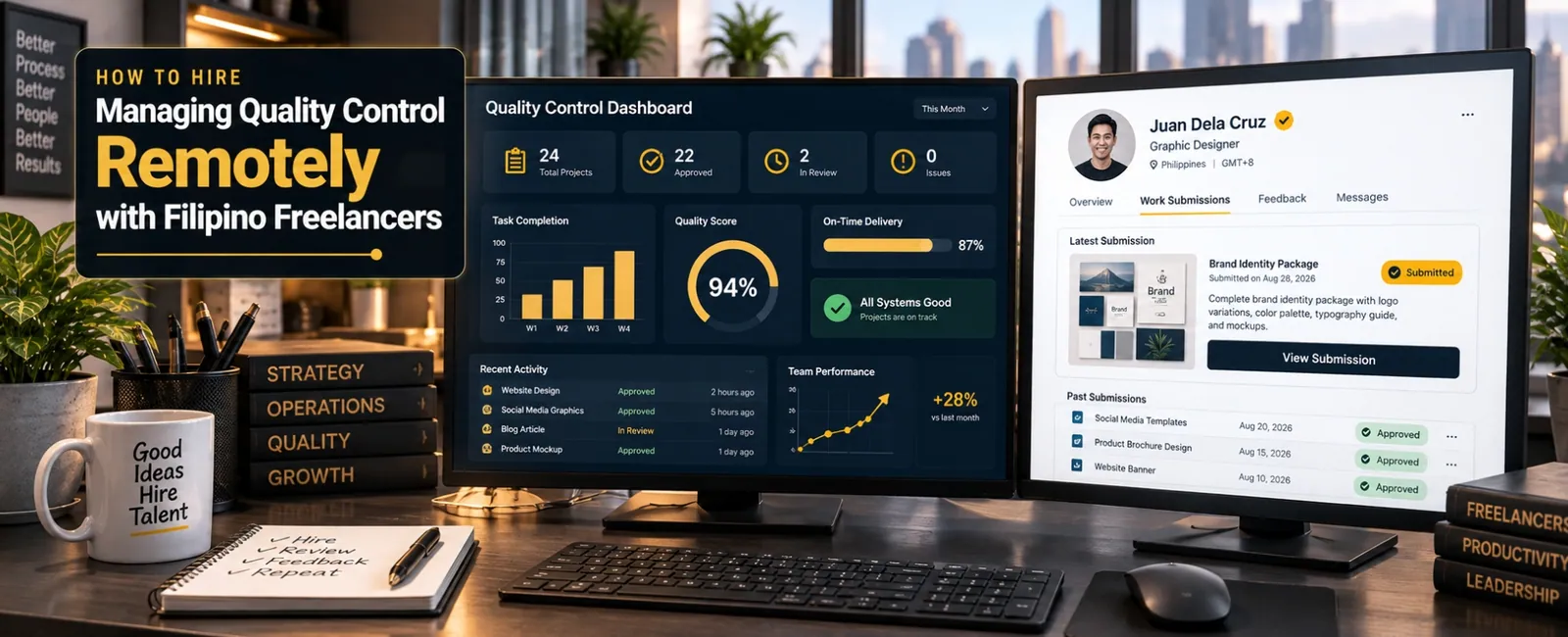
The most successful international buyers working with Filipino freelancers share one thing in common: they invested in building a quality control system before problems appeared rather than after. Quality control is not about distrust. It is about creating the conditions where a talented Filipino freelancer can consistently deliver their best work without ambiguity about what good looks like.
Filipino freelancers are widely recognized for their strong work ethic, professional communication, and genuine commitment to client satisfaction. The quality issues that do arise in remote engagements are almost never caused by lack of effort. They are almost always caused by unclear expectations, vague briefs, or the absence of a structured review process on the buyer's side.
The key insight: A Filipino freelancer who receives a detailed SOP, a clear checklist, and specific feedback on their first submission will almost always produce significantly better work on their second submission. The investment in your quality control system pays dividends in every subsequent deliverable. For a foundational understanding of freelancing terms you will encounter when building your QC processes, our Freelancing Terms Glossary covers key concepts including scope, retainer, and inbound orders.
Five Best Practices for Remote Quality Control
These five practices form the core of an effective remote QC system regardless of the task type or the experience level of your Filipino freelancer.
Set Clear Standards with Detailed SOPs and Checklists
Write detailed standard operating procedures and checklists before assigning any task. Your SOP should cover exactly what the output looks like when it is done correctly, what tools to use, what format to follow, and what common mistakes to avoid. A checklist that the freelancer completes before submitting their work eliminates the majority of basic quality issues before they reach your review stage.
Use Project Management Tools to Track Progress and Catch Errors Early
Manage all tasks through a shared project management platform such as Asana, ClickUp, or Trello. Setting up a Review pipeline stage where all completed tasks sit before final approval gives you a structured point to conduct quality checks without disrupting the freelancer's workflow. Tools like Asana allow you to attach SOPs and checklists directly to task templates so your freelancer always has the standards in front of them.
Conduct Sample Audits at Regular Intervals
Review a small percentage of completed work initially, then scale your audit frequency based on the freelancer's accuracy rate. For new engagements, auditing 20 to 30 percent of output in the first month is reasonable. For established freelancers with a strong track record, a random spot check of 5 to 10 percent monthly is sufficient. The goal is verification not surveillance.
Maintain Open Communication Through Structured Channels
Schedule brief weekly check-ins for alignment on priorities and upcoming tasks while relying on chat platforms like Slack or Microsoft Teams for daily updates and quick questions. Setting up dedicated channels for QC feedback such as a hash-tag-qc-feedback channel keeps quality discussions organized and separate from general project communication. Filipino freelancers respond well to structured communication frameworks that make expectations clear without requiring constant supervision.
Provide Specific and Constructive Feedback Quickly
Point out specific mistakes immediately and explain exactly how to fix them to prevent recurring issues. Vague feedback such as this does not look right or please improve quality is not actionable and creates frustration on both sides. Specific feedback such as the headline is missing the target keyword and should be under 60 characters gives the freelancer a clear correction path. The faster you provide feedback after a submission the faster the quality improvement cycle completes.

A structured quality control system built before problems arise is significantly more effective than reactive corrections after quality issues have already affected your deliverables or client relationships.
How to Write Effective SOPs for Filipino Freelancers
A well-written SOP is the single most impactful investment you can make in your remote QC system. Here is a practical format that works consistently with Filipino freelancers across all task types.
Structure Your SOP in Four Sections
- Objective: One or two sentences explaining what this task is and why it matters. Give the freelancer context for how their work fits into the bigger picture.
- Step-by-step instructions: Number each step clearly. Use screenshots where possible. Specify which tools to use for each step. Include examples of correct and incorrect output where helpful.
- Quality checklist: A short list of items the freelancer must verify before submitting. This checklist is the first line of quality control and catches the majority of preventable errors.
- Common mistakes to avoid: Document the most frequent errors you have seen or anticipate. This section becomes more valuable over time as you add real examples from your team's work.
Pro tip: Record a short Loom video walkthrough of your SOP when you first create it. Filipino freelancers respond particularly well to video explanations because they can see the process in action rather than interpreting written instructions alone. A three to five minute Loom recording alongside your written SOP dramatically reduces onboarding time and first-submission errors. For more on managing pricing and scope expectations with your Filipino freelancer, our Package Pricing vs Custom Quotes guide covers how Filipino specialists structure their deliverables.
Task-Specific Quality Control Workflows
Different task types require different QC approaches. Here are the most effective workflows for the four most common categories of work that international buyers outsource to Filipino freelancers.
Content Writing and Copywriting
QC Approach: Implement a two-tier review system covering Writer then Editor then Publish. Use automated style guides and grammar checking tools.
Action: Provide a strict brand voice guide and a submission checklist covering formatting, tone, SEO requirements, and word count. Use Grammarly as a baseline grammar check before editorial review.
For Filipino copywriting resources see our Hiring a Filipino Copywriter guideCustomer Support and Lead Generation
QC Approach: Conduct regular ticket audits and review recorded interactions. Grade based on a Customer Satisfaction matrix, response time, and script adherence.
Action: Build a CSAT scoring matrix covering empathy, resolution time, and accuracy. Audit a minimum of 10 percent of interactions weekly and share scores with your freelancer in a structured feedback session.
Spot check frequency: Weekly for new hires, Monthly for established teamGraphic Design and Video Editing
QC Approach: Use visual and timestamped feedback loops instead of vague text descriptions. Require storyboard or wireframe sign-off before final render.
Action: Use Loom for visual feedback recordings and Frame.io for frame-by-frame video notes. Always require an initial concept approval before the freelancer invests hours into final production. For Filipino web developer quality standards, see our Hiring a Filipino Web Developer guide.
Key rule: Never skip the concept approval stageData Entry and Administrative Tasks
QC Approach: Build validation rules directly into databases and spreadsheets. Use systematic spot-checking rather than reviewing every entry.
Action: Randomly audit 5 to 10 percent of data sets weekly to check for accuracy and formatting errors. Use conditional formatting in Google Sheets to automatically flag entries that fall outside expected parameters, reducing manual review time significantly.
Audit rate: 20-30% first month, 5-10% ongoingRecommended Tech Stack for Remote Quality Control
The right tools make quality control systematic rather than reactive. Here is a practical tech stack organized by function that international buyers use effectively with Filipino remote teams.
| Category | Tools | Primary QC Use Case |
|---|---|---|
| Project Management | Asana, ClickUp, Trello | Setting clear subtasks, attaching SOPs, and moving tasks through a Review pipeline before final approval |
| Asynchronous Feedback | Loom, Vidyard | Recording quick video walkthroughs to explain edits or point out visual errors, preventing miscommunication from text-only feedback |
| Content and Proofing | Grammarly, Hemingway, Frame.io | Automating baseline grammar checks for written content and providing frame-by-frame video feedback for creative deliverables |
| Time and Activity Tracking | Time Doctor, Hubstaff | Ensuring accountability for hourly contracts by tracking active hours. Always disclose tracking to your freelancer before implementation |
| Communication | Slack, Microsoft Teams | Setting up dedicated QC feedback channels to resolve quick questions instantly without cluttering general project channels |
When hiring verified Filipino specialists through Zinn Hub, all platform communication is text-based and centralized giving you a built-in audit trail of all client and freelancer interactions without requiring additional communication tools for basic coordination.
Giving Feedback That Actually Improves Quality
The quality of your feedback directly determines how quickly your Filipino freelancer improves. Vague or delayed feedback creates frustration and allows the same mistakes to repeat across multiple submissions. Specific, timely feedback accelerates the learning curve and builds a stronger working relationship.
The Feedback Formula That Works
- Identify the specific issue: Reference the exact line, element, or section that needs correction. Never give general feedback on a whole document or deliverable without identifying specific problem areas.
- Explain why it is an issue: Give the freelancer the reasoning behind the correction. Understanding why something is wrong prevents the same mistake from recurring and builds the freelancer's judgment over time.
- Show what correct looks like: Provide an example, a reference, or a rewritten version of the correction where possible. Showing is always faster than describing.
- Acknowledge what is working: Filipino professionals respond well to balanced feedback that recognizes strengths alongside areas for improvement. This is not flattery. It is communication that builds a productive and sustainable working relationship.
Timing matters: Feedback delivered within 24 hours of submission is significantly more effective than feedback delivered days later. The freelancer's memory of their decision-making process is fresh and corrections are easier to understand and apply. Build feedback turnaround into your weekly workflow as a non-negotiable priority.
For a broader perspective on the challenges Filipino freelancers navigate on their end, our Mga Hamon sa Freelancing guide gives international buyers valuable insight into the working conditions and pressures your Filipino freelancer manages daily.
Skill Gap vs Communication Gap: How to Tell the Difference
Not all quality issues have the same root cause and the correct response depends entirely on accurately diagnosing whether you are dealing with a skill gap or a communication gap.
- Signs of a Communication Gap: The freelancer produces work that is technically competent but consistently misses your specific preferences or brand requirements. They ask few clarifying questions. Their output improves significantly when given more detailed briefs. This is a systems problem on your side and the solution is a better SOP not a new freelancer.
- Signs of a Skill Gap: The freelancer produces work with consistent technical errors that do not improve even after specific feedback and clear examples are provided. The same mistakes repeat across multiple revision cycles despite detailed correction guidance. This may indicate a mismatch between the freelancer's actual skill level and the requirements of the role.
- When to Coach vs When to Escalate: Give any new freelancer a minimum of three to four revision cycles with specific feedback before concluding that a skill gap exists. Most quality issues in the first month of a new engagement are communication gaps that resolve with better systems. If quality issues persist after consistent specific feedback over four or more submission cycles, it is appropriate to reassess the engagement.
Building a Long-Term Quality Improvement Culture
The goal of your quality control system is not just error prevention. It is the creation of a working environment where your Filipino freelancer continuously raises their own standards because they understand your expectations deeply and genuinely care about the outcome.
Filipino professionals place a high cultural value on long-term professional relationships and on the reputation they build with the clients they work with. A buyer who invests in clear expectations, timely feedback, and genuine recognition of good work will almost always receive a higher level of commitment and quality improvement over time than a buyer who treats every engagement as transactional.
Schedule a monthly quality review session with your freelancer that covers what is working well, what needs improvement, and what goals you want to set for the next month. This conversation signals that you are invested in their growth and not just monitoring their output. That signal matters deeply in Filipino professional culture.
For more guidance on finding and vetting Filipino freelancers with verified credentials and transparent work histories, see our overview of Zinn Hub as the best multilingual freelance marketplace for international buyers.
Ready to find quality-verified Filipino freelancers for your remote team?
Browse verified Filipino specialists on Zinn Hub. All Zinners are identity-verified with Trust Badges and zero buyer fees on every transaction.
Browse Verified Filipino Specialists on Zinn HubFrequently Asked Questions
How detailed does an SOP need to be for a Filipino freelancer?
More detailed than you think is necessary. Filipino freelancers are trained to follow instructions precisely and will work with exactly the level of detail you provide. An SOP that feels overly detailed to you will feel appropriately thorough to a professional freelancer who wants to get it right the first time. Include screenshots, examples of correct and incorrect output, and a submission checklist as a minimum. A Loom video walkthrough alongside the written SOP further reduces first-submission errors significantly.
How often should I audit my Filipino freelancer's work?
For new engagements in the first month, audit 20 to 30 percent of output to establish a quality baseline and identify any systematic issues early. For data entry and administrative tasks, a random 5 to 10 percent spot check weekly is standard practice. For creative tasks such as writing and design, review all deliverables initially then move to selective audits once the freelancer has demonstrated consistent quality over at least four to six submission cycles.
What is the best way to give feedback to a Filipino freelancer without damaging the relationship?
Be specific, be timely, and acknowledge what is working alongside what needs improvement. Avoid general criticisms of quality without identifying specific issues. Frame corrections as collaborative problem-solving rather than disciplinary actions. Filipino professionals respond very well to feedback that is direct but respectful and that includes clear examples of what the correct version looks like. The goal of every feedback interaction is the freelancer's improvement not their discomfort.
Should I use time tracking software with my Filipino freelancer?
For hourly contracts, time tracking tools like Time Doctor or Hubstaff provide useful accountability data and are widely accepted in the Filipino freelancing community. However always disclose that you are using tracking software before implementation and explain clearly what data is being collected and why. Unannounced surveillance damages trust significantly and is counterproductive to the quality culture you are trying to build. For project-based engagements, time tracking is generally unnecessary as the focus is on deliverable quality rather than hours worked.
How long should I give a new Filipino freelancer before expecting consistent quality?
For most task types, expect the first two to three submissions to require more feedback and revisions than subsequent work as the freelancer calibrates to your specific standards and brand requirements. By the fourth or fifth submission with consistent specific feedback, most Filipino freelancers are producing work that requires minimal revision. If quality issues persist beyond six to eight submission cycles despite specific feedback, reassess whether the engagement is the right fit for both parties.
What is the difference between quality control and micromanagement?
Quality control is a systems approach that sets clear standards upfront, conducts structured audits at defined intervals, and provides specific feedback through established channels. Micromanagement is the unstructured monitoring of every step of a freelancer's work process in real time. Filipino freelancers thrive with clear standards and regular structured feedback. They disengage quickly when subjected to constant check-ins and second-guessing of their work methods. The goal is to control the output quality not the process.